EF Logo

truckmade by PeterbiltUSA, Global

Peterbilt 386Specs, dimensions, weight and engine

Engine
Cummins ISX/ISX15
Horsepower
485 hp
362 kW
Est. new price
~$215k

Quick answer

The Peterbilt 386 is a truck with a Cummins ISX/ISX15 engine rated at 362 kW (485 hp). Its height is 2.068 m. It suits moving machines on low-bed trailers, hauling containers and materials and long-distance and cross-border haulage. Its rivals include the Peterbilt 389 and the DAF XF (9.31 t).

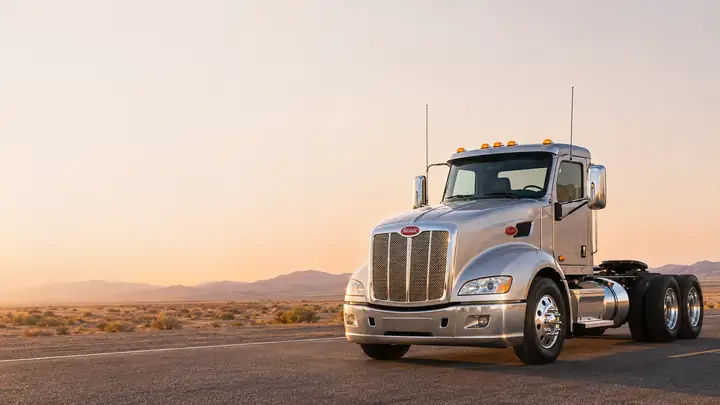
Peterbilt 386 (illustration)

What engine is in the Peterbilt 386?

The Peterbilt 386 is offered with Cummins ISX/ISX15, Cummins ISL and PACCAR MX-13; ISX12 G and ISL G natural-gas versions are also drawn in the manual. The sheet's power figure is 362 kW (485 hp) gross (Top PACCAR MX-13 rating at its 2010 launch for the 386; range 380-485 hp; from The Auto Channel (Peterbilt release)).

Cummins fault codes

Peterbilt 386 vs Peterbilt 389: what is the difference?

The Peterbilt 386 and the Peterbilt 389 are both trucks; this is where their sheets differ. The Peterbilt 389 has more gross power (380 kW against 362 kW), has more torque (2,508 Nm against 2,373 Nm) and carries more fuel (568 L against 567.8 L). Both sets of figures are the makers’ own, for the builds on our sheets.

Peterbilt 386 dimensions

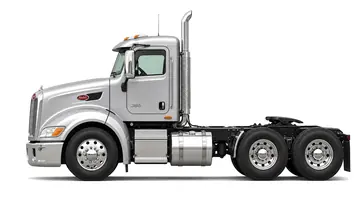
Peterbilt 386, side view with dimensions (illustration)
Side view
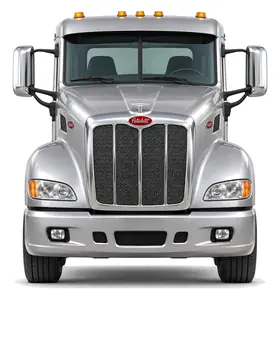
Peterbilt 386, front view (illustration)2.41 m
Front view
Overall width
2.41 m

Illustration; figures from the maker's sheet.

How big is the Peterbilt 386?

Drawn to one scale from the maker’s dimension drawing, on one ground line.

Peterbilt 386 drawn to scale beside a person, a pickup truck and a 40 ft container. The Peterbilt 386 is about 10 m long - 82% of a forty-foot container's length - and about 3 m tall, 1.7 times a person's height.Peterbilt 386about 10 × 3 mPerson1.75 m tallPickup truck5.3 × 1.8 m40 ft container12.19 × 2.59 m
The Peterbilt 386 is about 10 m long - 82% of a forty-foot container's length - and about 3 m tall, 1.7 times a person's height.

Peterbilt 386 specifications

Figures are the maker's unless marked: est. is our estimate, and any figure from another site names it. Each links to where it came from. Sheet last updated 17 November 2026.

40 figures in 3 groups, each with its source

Dimensions

Dimensions, part 1 of 2
FigureValue (metric)Source
Bumper to back of cab (BBC)3.211 mDay cab, standard 1.9 m cab; to front of bumper[1] p.13
Front overhang1.26 mBumper to front axle centreline[1] p.13
Front axle to back of cab1.951 m[1] p.13
Bumper to front of cab roof1.93 mBumper to the top front edge of the cab roof, top view and LH view[1] p.13
Bumper to rear of hood1.709 mBumper to the hood/cowl junction at hood top[1] p.13
Front of frame to front axle0.904 mFFA[1] p.13
Bumper to front of frame0.356 mBFF[1] p.13
Cab roof height above frame2.068 mFrom bottom of frame rail, standard day cab; 81.5 in in Table 3-13 (see conflicts)[1] p.13
Overall width2.413 mTop view of the overall-dimensions drawing; excludes mirrors[1] p.13
Dimensions, part 2 of 2
FigureValue (metric)Source
Overall cab height (extended day cab, add)0.147 mAdd to the overall cab height for extended day cab configurations[1] p.45
Cab to sleeper gap0.058 mGap between cab and sleeper, dimension E[1] p.26
Sleeper roof height above frame (44 in sleeper)2.126 mFrom bottom of frame rail; 36 in sleeper box length[1] p.26
Sleeper roof height above frame (58 in low roof)2.172 m48 in sleeper box length[1] p.26
Sleeper roof height above frame (58 in high roof)2.576 m48 in sleeper box length[1] p.26
Sleeper roof height above frame (72 in low roof)2.167 m63 in sleeper box length[1] p.26
Sleeper roof height above frame (72 in high roof)2.578 m63 in sleeper box length[1] p.26
Sleeper roof height above frame (78 in)2.634 m70 in sleeper box length[1] p.26

Engine

Engine, part 1 of 2
FigureValue (metric)Source
Engine modelCummins ISX/ISX15, Cummins ISL and PACCAR MX-13; ISX12 G and ISL G natural-gas versions are also drawn in the manualEngine families the manual lists for the 386 in its exhaust height table (ISX/MX, ISL); the manual gives no ratings[1] p.43
Displacement12.9 L[2] p.2
Bore x stroke130 x 162 mm[2] p.2
ConfigurationInline 6-cylinder[2] p.2
Dry weight1,134 kg[2] p.2
Engine, part 2 of 2
FigureValue (metric)Source
Governed speed2,100 rpm[2] p.2
Gross power362 kW (485 hp)Top PACCAR MX-13 rating at its 2010 launch for the 386; range 380-485 hp; from The Auto Channel (Peterbilt release)[3]
Max torque2,373 NmTop PACCAR MX-13 rating at its 2010 launch; from The Auto Channel (Peterbilt release)[3]
EmissionsEPA 2007, 2010 or 2013 (by build year)The manual covers 2007/10/13 emissions engines; the MX-13 entered the 386 as EPA 2010 certified[1] p.8

Chassis

Chassis, part 1 of 2
FigureValue (metric)Source
Cab1.9 m cab family (Models 389, 388, 386, 384, 367, 365), standard cab with Unibilt sleepers (44, 58, 72, 78 in); extended day cab option[1] p.27
Frame rail (single)10-5/8 in x 3.45 in flange x 0.313 in web, 14.8 in3 section modulus, 1,776,000 in-lb RBM per rail, 1.44 lb/in; also 10-3/4 in x 3.50 x 0.375 (17.8 in3) and 11-5/8 in x 3.87 x 0.375 (21.4 in3, 2,568,000 in-lb)Table 4-1[1] p.65
Frame rail (built-up)10-5/8 in main rail with 9.875 x 2.87 x 0.250 in insert (23.6 in3, 2,832,000 in-lb); 10-3/4 in with insert (28.9 in3), with insert and 11.63 x 3.87 x 0.375 in outsert (45.7 in3, 5,484,000 in-lb); 11-5/8 in with 10.75 x 3.50 x 0.375 in insert (37.7 in3, 4,524,000 in-lb)Table 4-2[1] p.65
Minimum clearance, top of rear tyre to body0.203 mMinimum clearance between the top of the rear tyre and the body structure overhang[1] p.66
Exhaust standpipe base height, side of cab (day cab)1.758 mBottom of frame rail to bottom of standpipe, Table 3-11[1] p.43
Exhaust standpipe base height, back of cab1.796 mBottom of frame rail to bottom of standpipe, Table 3-11[1] p.43
Exhaust standpipe base height, frame mounted2.156 mBottom of frame rail to bottom of standpipe, Table 3-11[1] p.43
Chassis, part 2 of 2
FigureValue (metric)Source
Exhaust standpipe base height, vertical-vertical (ISX/MX)1.963 mISL is 75.0 in; bottom of frame rail to bottom of standpipe[1] p.43
Battery box length (standard back-of-cab)1.039 mTable 3-17[1] p.46
Tool box length (standard back-of-cab)0.803 mTable 3-17[1] p.46
Space-saver battery box length (with step)0.716 m25.1 in without step, Table 3-17[1] p.46
Frame-mounted ladder step length0.325 mTable 3-17[1] p.46
Front suspensionTaper-leaf springs; 12,000, 13,200, 14,600, 16,000, 18,000-20,000 and 22,000-24,000 lb ratings; set-back front axleFrom the Peterbilt heavy-duty range frame-height tables, not listed per model (Table 3-4)[1] p.32
Rear suspensionPeterbilt Air Leaf, Low Air Leaf, Low Low Air Leaf, Flex Air, Air Trac and QuadraFlex; Hendrickson HMX, HN, R, RS, RT and RTE; Neway AD/ADZ; Reyco 79KB, 102 and 102AR; Chalmers 854/860 and 872From the Peterbilt heavy-duty range frame-height tables, not listed per model (Tables 3-5 to 3-10, p.33-35)[1] p.33

Build: Peterbilt Model 386 aerodynamic conventional, built from 2005 (the manual dates its first control-module build April 2005) until the mid-2010s; Peterbilt publishes no end date. Day cab drawing and sleeper table from the Peterbilt Heavy Duty Body Builder Manual (March 2015, Rev A); wheelbase is set per order and is drawn at 228 in.

  1. [1]Peterbilt Heavy Duty Body Builder Manual, March 2015 Rev A, Figure 3-3 Model 386 overall dimensions, Table 3-2, Fig. 3-17, Tables 3-11, 3-13 to 3-17, 4-1, 4-2
  2. [2]PACCAR MX-13 EPA 2024 spec sheet
  3. [3]The Auto Channel, Peterbilt delivers first PACCAR MX-equipped vehicle (June 2010)

Peterbilt 386 service

What each system holds and when Peterbilt says to change it, with genuine filters and oils. The oil grade for your build is in its operator's manual.

Service capacities

Fuel tank
567.8 L150 gal
Fuel tank (total capacity)
617 L163 gal
Fuel tank (23 in diameter, largest)
454.2 L120 gal
DEF tank (small)
41.6 L11 gal
DEF tank (medium)
78.4 L20.7 gal
DEF tank (large)
117.7 L31.1 gal

Peterbilt 386 against its rivals

The trucks nearest in weight from other makers, figure by figure, each shown at the same scale.

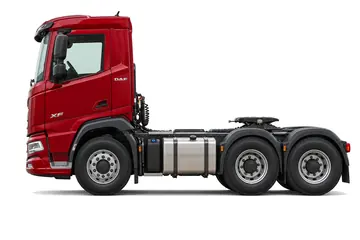
Peterbilt 386, Peterbilt 389, DAF XF, Freightliner Cascadia: specifications side by side
FigurePeterbilt 386this pagePeterbilt 389 specsDAF XF specsFreightliner Cascadia specs
Gross power362 kW (485 hp)380 kW (up to 510 hp)300 kW (408 hp)not on its sheet
Max torque2,373 Nm2,508 Nm2,150 Nmnot on its sheet
Fuel tank567.8 L568 L510 L775 L
Every figureFull sheet

Underlined: the figure that leads its row. Weight has no better way, so it is never marked. All figures are the makers' own.

  • The Peterbilt 386 leads none of these figures, so the choice comes down to price, hours and dealer support.
  • Pick the Peterbilt 389 if you need more gross power (380 kW) and more torque (2,508 Nm).
  • Pick the Freightliner Cascadia if you need a bigger fuel tank (775 L).

Peterbilt 386 prices and listings in the UAE

Asking prices on EquipmentsFinder, in AED, refreshed daily.

A new Peterbilt 386 costs about $215,000 (USD), base machine before options, freight and tax - an estimate from new units for sale, checked November 2026. Sources: truckpaper.com.

Typical hire, per daymedian of 11

AED 600 /day

No priced Peterbilt 386 for hire yet: this is all trucks

Low AED 267High AED 1,500

No Peterbilt 386 for rent listed right now.

Request a Peterbilt 386

Tools for a Peterbilt 386

For the people who run one: codes, charts and calculators that fit a truck.

Ranked: Semi trucks and heavy trucks by horsepower

Semi trucks and heavy trucks by horsepower rated at 350 hp and up, most powerful first. The Peterbilt 386 is 21 of 40; every figure is the maker's.

  1. 17Scania R 500373 kW
  2. 18Volvo VNL373 kW
  3. 19Volvo FH 500368 kW
  4. 20Kenworth T660362 kW
  5. 21Peterbilt 386This page362 kW
  6. 22DAF CF355 kW
  7. 23Freightliner Century Class339 kW
  8. 24Isuzu Giga338 kW
  9. 25Iveco S-Way338 kW

Showing 17 to 25 of 40, the machines nearest the Peterbilt 386 by engine power.

Popular Peterbilt truck models

Peterbilt 386 fault codes and serial number

J1939 engine fault codesDecode a Peterbilt VIN

More Peterbilt 386 questions

How wide is a Peterbilt 386?

2.41 m (7 ft 11 in) overall.

How much torque does a Peterbilt 386 have?

2,373 Nm (1,750 lb-ft).

What is the Peterbilt 386's fuel tank capacity?

567.8 L (150 gal).

What are the Peterbilt 386's main competitors?

The machines nearest it in size are the Peterbilt 579, the DAF XF and the Freightliner Cascadia. Each has a side-by-side comparison on EquipmentsFinder.

Is the Peterbilt 386 sold in the UAE?

Not new through a Gulf dealer: it is sold in the USA and other markets worldwide. Used and imported machines do come up on EquipmentsFinder.

What is a Peterbilt 386 used for?

A heavy truck: the cab and drive unit that hauls trailers, tippers and tankers between sites, yards and ports. Typical jobs: moving machines on low-bed trailers, hauling containers and materials, long-distance and cross-border haulage, pulling tankers and tippers.

Embed this spec card

The Peterbilt 386's key figures as a small card for your own page. Copy the code and paste it where the card should go; the card stays up to date with the sheet here.

<iframe src="https://www.equipmentsfinder.com/embed/models/peterbilt-386" title="Peterbilt 386 specs" width="100%" height="480" style="border:0;max-width:480px" loading="lazy"></iframe>
<p style="font-size:12px"><a href="https://www.equipmentsfinder.com/models/peterbilt-386">Peterbilt 386 specs</a> by <a href="https://www.equipmentsfinder.com">EquipmentsFinder</a></p>

Calculators and other cards to embed are in the embed kit.

Need a Peterbilt 386 on site?

Post the job: where, when and for how long. Suppliers with a machine contact you directly. Free to post.

Post a request
EquipmentsFinder

Need equipment? Have equipment?

Buyers post one request and get quotes from suppliers. Suppliers list free and reach active demand.