How to Hire a Mobile Crane in the UAE: Tonnage, Lift Plans, Terms
Pick crane tonnage from the load chart, not the name on the boom. UAE certification rules, operators, ground mats, hire terms and a quote checklist.
By Sufian10 min read
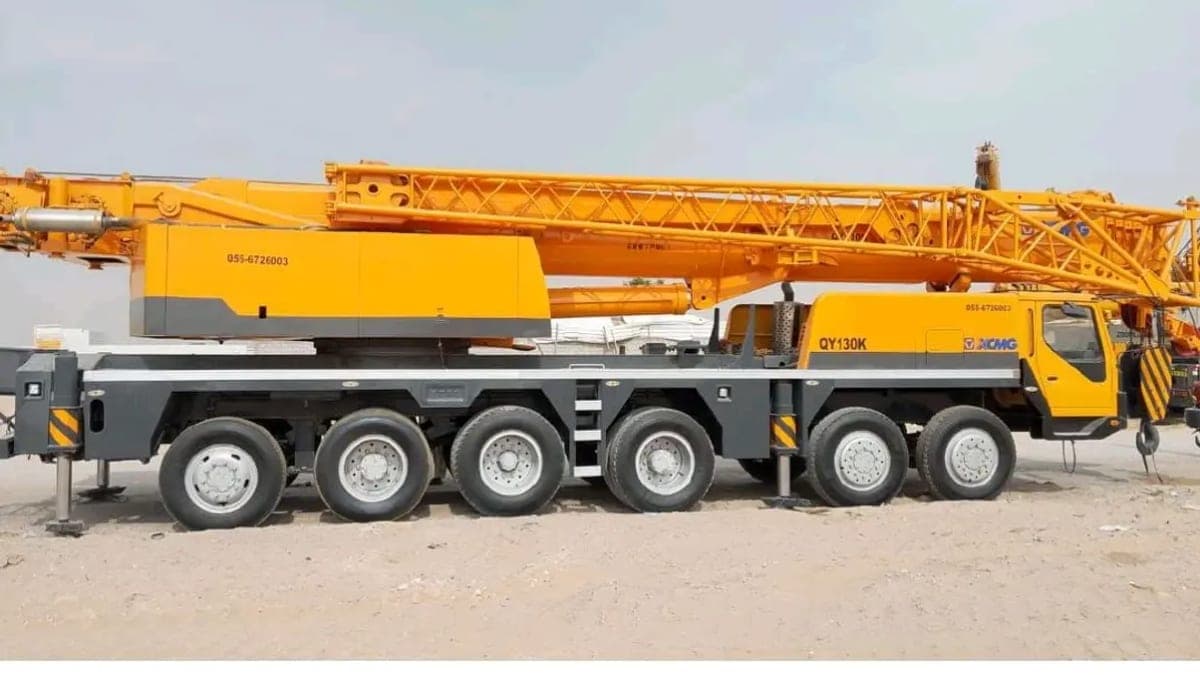
To hire the right mobile crane in the UAE, start with three numbers: the total weight you are lifting, the radius from the crane's centre of rotation to where the load sits, and the boom length needed to clear whatever is in the way. Take those to the crane's load chart. The tonnage on the side of the crane is its best case at very short radius, and most site lifts happen nowhere near it. Then check the third-party certificates, the ground under the outriggers, and the hours and extras in the quote.
Read the load chart, not the headline tonnage
A "50 tonne" crane lifts 50 tonnes only with the boom fully retracted, the hook almost under the boom head and the most counterweight it can carry. Every metre of radius and every extra metre of boom takes capacity away, and the drop is steep.
Here is an example built on one published chart. Liebherr publishes the chart for its LTM 1050-3.1, a 50 t all-terrain crane, in the configuration it supplies to fire brigades: 4.4 t of counterweight, on outriggers, slewing through 360 degrees. In that set-up the highest figure on the whole chart is 42 t, at 3 m radius on the shortest boom (11.4 m). At 8 m radius the same boom is down to 15.6 t.
Now a typical job. You need to set a 5.5 t rooftop chiller on a low-rise building. A boundary wall and a soakaway keep the crane 12 m from the drop point, and you need about 27 m of boom to clear the parapet. Add the spreader beam, slings and shackles, and the hook block, because the chart capacity includes everything hanging below the boom head (Liebherr's own chart notes say the hook block weight must be deducted). Say that comes to 6.2 t in total.
| Radius | Capacity on the 27.3 m boom | 6.2 t lift as % of chart |
|---|---|---|
| 12 m | 8.2 t | 76% |
| 14 m | 6.3 t | 98% |
| 16 m | 5.0 t | Over capacity |
Figures as read from Liebherr's LTM 1050-3.1 data sheet (4.4 t counterweight configuration), to show how fast capacity falls with radius. Plan a real lift from the chart for the exact crane, boom and counterweight on your job.
Two metres of extra radius take the lift to the edge of the chart, and two more make it impossible. At 16 m you need a bigger crane, more counterweight or a different set-up position.
So measure radius on a drawing, to the furthest point the load must reach, including where it lands. Ask the supplier for the chart page that matches the configuration they will actually send: boom length, counterweight and outrigger spread. And leave a margin: many contractor and client procedures treat a lift above a set percentage of chart as a critical lift needing extra sign-off, so find out that threshold first.
Common sizes and what they do on UAE sites
These are the four sizes people search for most, with the number of rental listings on EquipmentsFinder in late October 2026 that state that capacity.
| Size | Listings stating it | Typical UAE work | Watch for |
|---|---|---|---|
| 25 t | 36 | Steel members, sign gantries, generators, AC package units, container moves at short radius | Capacity falls off fast past 10 m |
| 50 t | 74 | Precast stairs and slabs, rebar cages, rooftop plant on low-rise buildings, light warehouse steel | The worked example above: reach decides, not tonnage |
| 100 t | 61 | Warehouse portal frames at longer reach, heavier precast, transformers, tower crane erection and dismantling depending on the tower crane | More counterweight trucks, a bigger set-up footprint |
| 200 t and above | 22 at 200 t, 17 at 250 t | Bridge and flyover girders, long-reach lifts over buildings, plant modules on industrial sites | Engineered lift plan, ground study, several days of mobilisation |
The 50 t class is the most common size listed in the UAE, followed by 100 t. There are also 21 listings at 160 t, 11 at 150 t and 10 at 70 t, useful when a job sits between the usual steps. You can see all 429 mobile cranes for rent from 152 suppliers on the mobile cranes page.
What it costs
Across the rental listings on EquipmentsFinder in late October 2026 that publish a rate, a mobile crane typically costs about AED 2,250 a day (middle half AED 1,500 to 4,500) and about AED 32,000 a month (middle half AED 22,000 to 50,000). Too few listings at any one tonnage publish a rate to price by size, so treat these as a market range. For buyers, 56 mobile cranes are listed for sale, at a typical asking price of about AED 300,000.
| Size | Listings | Rent per day | Rent per week | Rent per month | To buy (used) |
|---|---|---|---|---|---|
| All Cranes | 687 | AED 2,250 | AED 12,000 | AED 33,000 | AED 460,000 |
Operator, rigger and signaller
Mobile cranes in the UAE are normally hired with the supplier's operator. In Dubai, the Municipality's Code of Construction Safety Practice requires crane operators to be trained, qualified and approved by Dubai Municipality, and requires a single appointed signal person who is trained and approved to give signals to the operator. Operators of cranes and other lifting equipment must also be tested every 12 months by an approved third-party inspection body, which issues each one a qualifying certificate.
Ask for the operator's name and a copy of that certificate before the crane arrives, and check the expiry. Agree in writing who supplies the rigger and signaller, because a crane standing idle while you look for a certified banksman is still on hire.
In Abu Dhabi, construction work falls under the Occupational Safety and Health System Framework (OSHAD-SF), supervised by the Abu Dhabi Public Health Centre. Oil and gas clients and large developers add their own lifting rules, so get the client's HSE requirements before you ask for quotes.
Third-party certification and lift plans
Dubai's code sets out what a mobile crane needs before it works on a site:
- A thorough examination every 12 months by a competent person from a third-party company approved by Dubai Municipality, with a test certificate. The crane must be re-examined after repairs, alterations or weather that may affect its strength or stability.
- A valid safety certificate before it is allowed onto site, with the crane's and operator's details recorded and kept there.
- Rigging gear such as chains, wire ropes, shackles and eyebolts inspected every 6 months.
- In the cab: the manufacturer's manual, the load chart for all configurations, operating speeds and the limits for windy weather.
- An automatic safe load indicator, boom angle and boom length indicators, and an anti-two-block switch.
- No crane over 25 years of service unless it has a safety and quality certificate from the manufacturer and non-destructive testing of the whole structure.
- Aircraft warning lights on mobile cranes with a boom longer than 30 m, under Dubai Civil Aviation Authority rules.
The code also requires a risk assessment before any major or special lift. In practice that becomes a written lift plan: load weight, radius, chart capacity, rigging, exclusion zone and the person in charge. BS 7121-1 is a widely used reference for managing crane lifts on construction sites.
Three more site rules from the code: keep cranes at least 3 m from power lines, keep them back from a trench edge by one and a half times its depth, and have a way to measure wind on site. The code recommends stopping work completely at 38 km/h. Cladding panels and AHUs catch the wind and can hit their limit well before that.
Ground bearing and outrigger mats
The crane's weight and the load end up on four outrigger pads, and the ground has to take it. Dubai's code requires a stable, level base and timber mats under each outrigger suited to the soil.
Ask the supplier for the maximum outrigger load for your lift, which they can calculate from the manufacturer's planning software. The arithmetic is simple: pressure is load divided by mat area. If one leg puts 30 t down on a 1 m × 1 m mat, the ground sees 30 t per square metre. On a 2 m × 2 m mat it sees 7.5 t per square metre. Compare that with what your engineer says the ground can take.
On UAE sites, the risky spots are fresh trench backfill, interlock paving over services, reclaimed land and soft coastal sabkha. If you do not know what is under the pad, find out before the crane rigs up.
Hire terms to pin down
- What a "day" means. Get the shift length in hours and any minimum charge in writing.
- Mobilisation and demobilisation. Separate one-off charges. Bigger cranes often travel without full counterweight, which follows on extra trucks. Ask whether those are in the price.
- Overtime. UAE labour law sets an 8-hour working day and generally caps overtime at 2 hours a day. Beyond 10 hours you need a second operator, so ask how that is charged.
- Friday and public holidays. Some suppliers charge a premium, others include them in a monthly rate. Agree it in advance.
- Ramadan and summer. Working hours drop by 2 hours a day in Ramadan. From 15 June to 15 September, outdoor work in direct sun is banned from 12:30 to 3:00 pm, and your riggers work outside.
- Standby and weather. Agree who pays when the crane waits for your load or a wind stop.
Checklist for the quote
- Load weight, including rigging and hook block
- Maximum radius and boom length, with the chart page for the configuration being sent
- Counterweight and outrigger spread at that configuration
- Crane model, year of manufacture and third-party certificate expiry
- Operator name and third-party operator certificate
- Who supplies the rigger and signaller
- Maximum outrigger load and who supplies the mats
- Shift hours, minimum charge, overtime and Friday rates
- Mobilisation, demobilisation and counterweight transport costs
- Standby and weather downtime terms
Send that list with your enquiry and the quotes that come back can be compared line by line. You can also post one request and let several suppliers price the same lift.
Common questions
How much does it cost to hire a mobile crane in the UAE? Published rates in late October 2026 were typically about AED 2,250 a day and AED 32,000 a month, before mobilisation, across all sizes. Too few listings publish a rate to price each tonnage, so get quotes for your exact lift.
What size crane do I need? The one whose load chart covers your total load at your radius and boom length, with a margin. The tonnage in the name is only its best case at very short radius.
Does a crane hire include the operator? Normally yes, in the UAE. Check who supplies the rigger and signaller, and ask for the operator's third-party certificate before the crane arrives.
Does a mobile crane need a certificate in Dubai? Yes. Dubai's construction safety code requires a thorough examination every 12 months by an approved third-party company, with a test certificate.
Sources
- Dubai Municipality, Code of Construction Safety Practice: section 2-15, Inspection and Permits; chapter on Cranes, general requirements and mobile cranes
- Liebherr-Werk Ehingen, LTM 1050-3.1 / LTM 1070-4.2 fire-brigade crane data sheet (p-189-00-e05-2016), lifting capacities on telescopic boom
- Liebherr, LTM 1050-3.1 technical data, notes to the load charts
- Abu Dhabi Department of Municipalities and Transport, About EHS: OSHAD-SF
- UK Health and Safety Executive, Lifting operations in construction (BS 7121-1)
- Gulf News, Working hours and overtime in the UAE
- Khaleej Times, Ramadan working hours under UAE labour law
- Khaleej Times, UAE midday break starts June 15
- Listings on EquipmentsFinder, late October 2026 (UAE mobile cranes for rent and for sale)