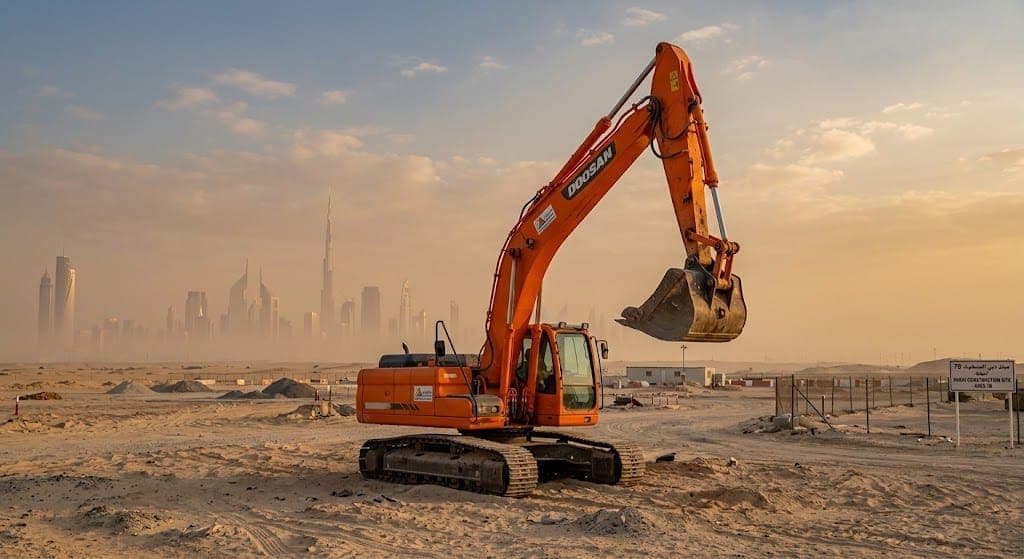
After the Midday Break: Booking Equipment for the UAE Q4 Peak
The UAE midday break ended on 15 September. What Q4 peak season does to crane and loader availability, how to book ahead and which machine checks to run.
By Sufian8 min read
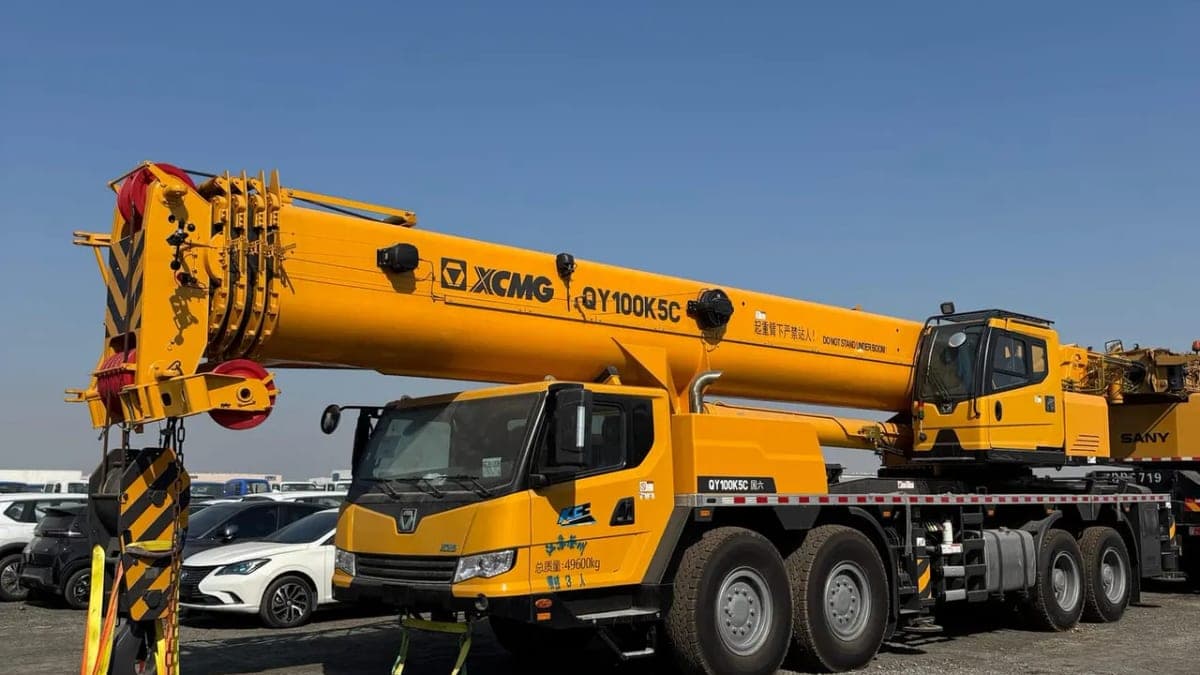
The UAE's summer midday work ban ended on 15 September, and with the first cooler mornings of late October the country's sites are now in their most productive stretch of the year. If you need a 100-ton mobile crane, a set of wheel loaders or a dozen excavators between November and March, the practical answer is simple: book now, fix the rate for the whole period, and refuse to take delivery of any machine that spent the summer in a yard until you have seen proof of four checks: cooling system, tyres, batteries and hydraulic oil. The rest of this piece explains why, and how to do it without overpaying.
What the 2026 midday break changed for equipment
The Ministry of Human Resources and Emiratisation (MoHRE) ran the break from 15 June to 15 September 2026, its 22nd consecutive year, banning work in direct sunlight and open areas from 12:30pm to 3:00pm every day, according to Gulf News (8 June 2026). Exemptions covered asphalt laying, concrete pouring, emergency repairs to water and electricity networks, urgent traffic works and other jobs that directly affect public safety. Employers had to provide shaded rest areas, drinking water, cooling and first aid. In previous years MoHRE has set the penalty at AED 5,000 per worker, up to AED 50,000 where several workers are involved.
For equipment, the break meant that for three months a day-hire machine lost two and a half hours of its most usable daylight. Many contractors reshaped their programmes around it: earthworks pushed to early mornings and night shifts, lifting deferred, finishing trades moved indoors. That deferred work does not disappear. It lands in Q4, on top of the work that was always planned for the cool season, and it lands on the same pool of machines and operators.
Why Q4 tightens the UAE hire market
Every year the period from October to March is when Gulf contractors try to bank progress. Concrete cures more predictably, operators can run full shifts, and clients want milestones hit before the next summer slows everything again. This year three things make the squeeze sharper.
First, the big public jobs are hungry. At Al Maktoum International Airport, Dubai Airports chief executive Paul Griffiths told The National (26 August 2026) that about 45 million cubic metres of earth had already been moved and some 17,000 piles driven, with about 9,000 workers on site rising to as many as 120,000 at peak. Dubai planned to award a further AED 55 billion of airport contracts by the end of 2026. On the Dubai Metro Blue Line, the Roads and Transport Authority (RTA) has targeted 30 per cent completion by the end of 2026. Each of these programmes absorbs cranes, loaders and trucks that would otherwise be available to smaller contractors.
Second, fleets cannot be topped up quickly. Khaleej Times reported on 16 September 2026 that vessel traffic at Jebel Ali had fallen sharply since the conflict around the Strait of Hormuz, with DP World moving more than 500,000 containers overland from the east coast to the Gulf coast this year. New machines, and the spare tyres and parts that keep older ones running, are arriving by longer routes. Our view: do not expect a wave of new imported units to ease hire rates this season. Rental companies will work with what is already in the country.
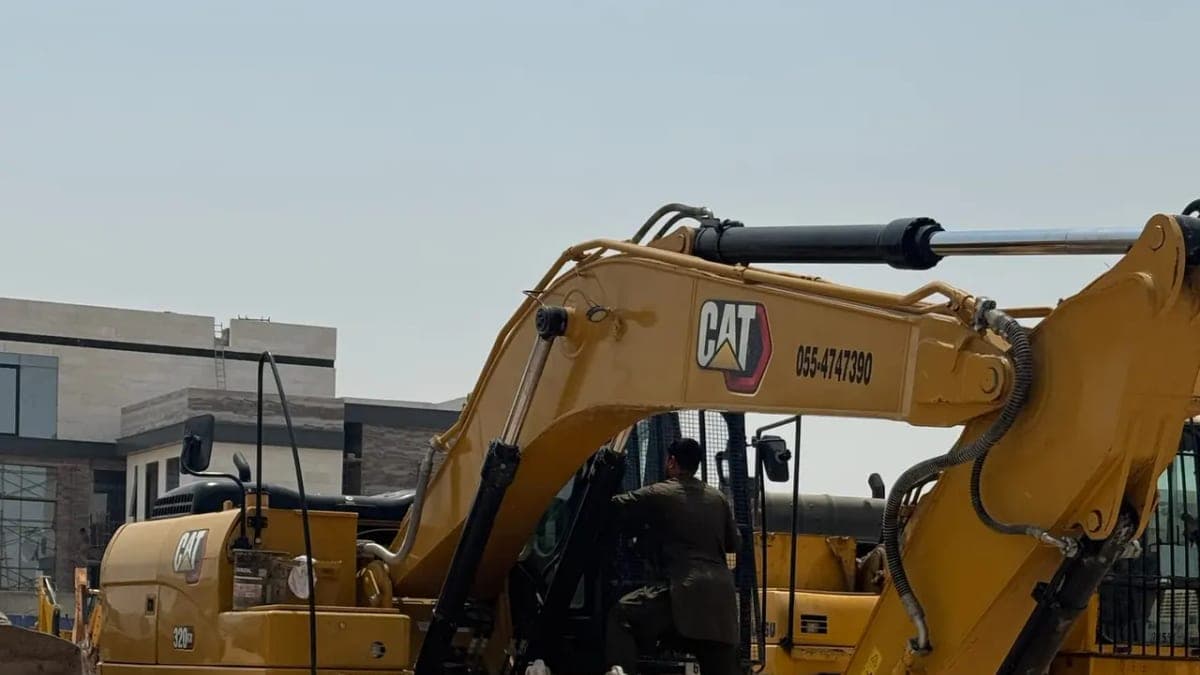
Third, operators are the real constraint. A 220-ton all-terrain crane is useless without a certified operator and rigger, and good excavator operators on a CAT 320 or Komatsu PC210 get poached by whichever site pays overtime first.
Which machines book out first
Not every category tightens at the same pace, and the order in Dubai, Abu Dhabi and Sharjah is fairly predictable.
| Machine | Typical Q4 work | Why it runs short | What to lock in |
|---|---|---|---|
| 100-ton and larger mobile cranes | Steel erection, precast, plant and MEP lifts | Few units in country, each needs a certified operator and rigging crew | Crane, operator and a third-party inspection certificate that covers the full hire |
| 50 to 80-ton truck and all-terrain cranes | General lifting, tower crane erection and dismantling | Used on almost every building site | Daily versus monthly rate, standby terms |
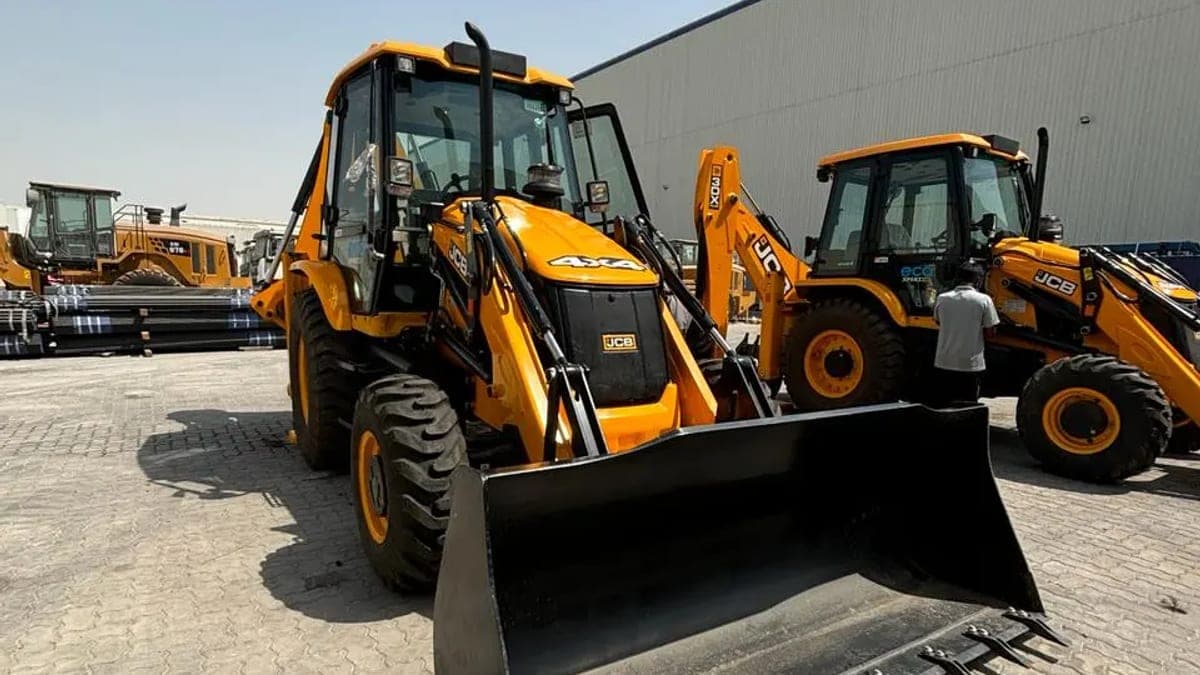
| Wheel loaders (CAT 966/980 class) | Stockpiles, aggregate yards, airport and road earthworks | Long-term infrastructure hires keep them off the market for months | Bucket size, tyre condition, replacement clause |
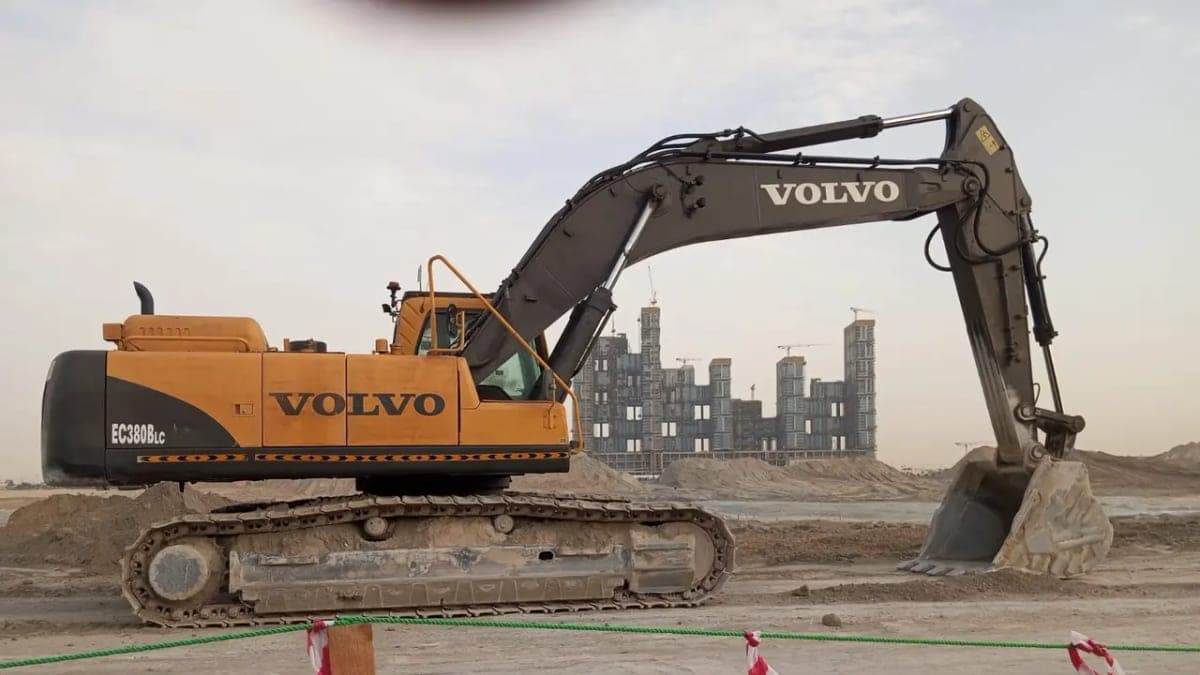
| 20 to 35-ton excavators | Utilities, foundations, villa plots | Machines are plentiful, skilled operators are not | Named operator, overtime rate |
| Telehandlers and boom loaders | Façade, roofing and MEP phases | Demand peaks as structures top out | Lift height and capacity at reach |
The pattern worth noticing: the scarcer the operator skill, the earlier the machine disappears. Excavators rarely run out entirely. 100-ton mobile cranes do.
How to book cranes and loaders ahead without overpaying
Start with the job, not the tonnage. A crane supplier quoting against "need a 100-ton crane" will pad the price to cover an unknown radius. Send the heaviest load, the radius, the hook height and the site access, and ask for the load chart of the exact machine offered. Often a well-positioned 60-ton machine does the lift that a vaguely specified 100-ton was going to do, at a lower monthly rate.
Ask for a monthly rate that holds for the whole period, in writing. Q4 rates move, and a daily quote that looked fine in October can be revised in January when the next big airport or metro package mobilises. A three or four-month booking gives the owner certainty, and that is what you are trading for a fixed price.
Read the hours clause now that the full working day is back. Check how many hours a shift covers, what overtime costs, whether Friday work is charged differently, and whether the operator's accommodation and transport are included. These details were less important in summer when sites ran short days. They matter a great deal in December.
Insist on a breakdown clause. For a loader or excavator, agree how quickly a replacement must arrive if the machine fails and whether you stop paying for the hours it is down. For cranes, confirm that the replacement will carry a valid third-party inspection certificate, because a replacement crane without paperwork is not a replacement.
If you need several categories at once, one detailed request saves days of phone calls. Post your requirement with dates, location and the lift or earthworks details, and owners can quote against the same specification. Current UAE crane rates are below as a reference point for those conversations.
| Size | Listings | Rent per day | Rent per week | Rent per month | To buy (used) |
|---|---|---|---|---|---|
| All Cranes | 687 | AED 2,250 | AED 12,000 | AED 33,000 | AED 460,000 |
Post-summer checks before you sign the handover
A machine that stood on an unshaded yard in Jebel Ali or Mussafah from June to September, or one that ran through it on night shifts, comes out of summer with predictable wear. Ask the owner for evidence on these four points before the machine moves to your site.
Cooling system. Fine Gulf dust packs radiator and charge-air cooler cores, and heat cycles harden coolant hoses. Ask when the cores were last blown out, look for a coolant test result, and check the fan belt for glazing. Many modern machines log overheating events in the engine controller. If the owner can show a clean fault log, that is worth more than any verbal assurance.
Tyres. Loader and grader tyres parked in the sun crack on the sidewalls long before the tread wears. Walk round and look at the sidewalls and the date codes, and check that pressures were set cold, first thing in the morning, not after the machine has been working. Earthmover tyres are expensive and, with shipping disruption, slow to replace. A cracked tyre on a wheel loader can park it for weeks.
Batteries. Heat does the damage in summer, and the first cool winter morning exposes it when the machine will not start. Ask for a load test result rather than a voltage reading, and check terminals for corrosion. On cranes and machines with heavy electronics, a weak battery also causes intermittent faults that are hard to trace.
Hydraulic oil. Long periods at high temperature oxidise hydraulic oil, and coastal humidity in August and September brings condensation into tanks. Dark oil with a burnt smell is a warning sign. The better owners take an oil sample after summer and change filters as a matter of routine. Ask to see the analysis, and look along hose runs for abraded covers and at cylinder rods for weeping seals.
For cranes, add the obvious: wire rope condition and lubrication, a calibration record for the load moment indicator, and an inspection certificate dated to cover your whole hire.
Send one request this week
Do this before the end of the week: list every lift and every earthworks task on your programme from mid-November to the end of February, with dates, then send it out as one request and fix monthly rates for the core machines. Make a dated service sheet covering cooling, tyres, batteries and hydraulic oil a condition of handover, and write that condition into the purchase order. The contractors who struggle in January are rarely the ones who paid a little more in October. They are the ones who waited.
For a wider view of the projects driving next year's demand, see our guide to UAE construction in 2027.
Sources
- Gulf News, "Midday outdoor work ban returns across UAE for 22nd year", 8 June 2026
- Gulf News, "Up to Dh50,000 fine for violating ban on working outdoors"
- The National, "Dubai to award Dh55bn in contracts by year end for Al Maktoum airport expansion", 26 August 2026
- Dubai Media Office, RTA Blue Line progress, November 2025
- Khaleej Times, "DP World says Strait of Hormuz will reopen", 16 September 2026