Cat 320 vs Komatsu PC200: Which 20-Tonne Excavator for the UAE?
The Cat 320 and Komatsu PC200 weigh within 100 kg of each other. Here is where the makers' sheets differ, and what to check before you hire or buy either one.
By Sufian7 min read
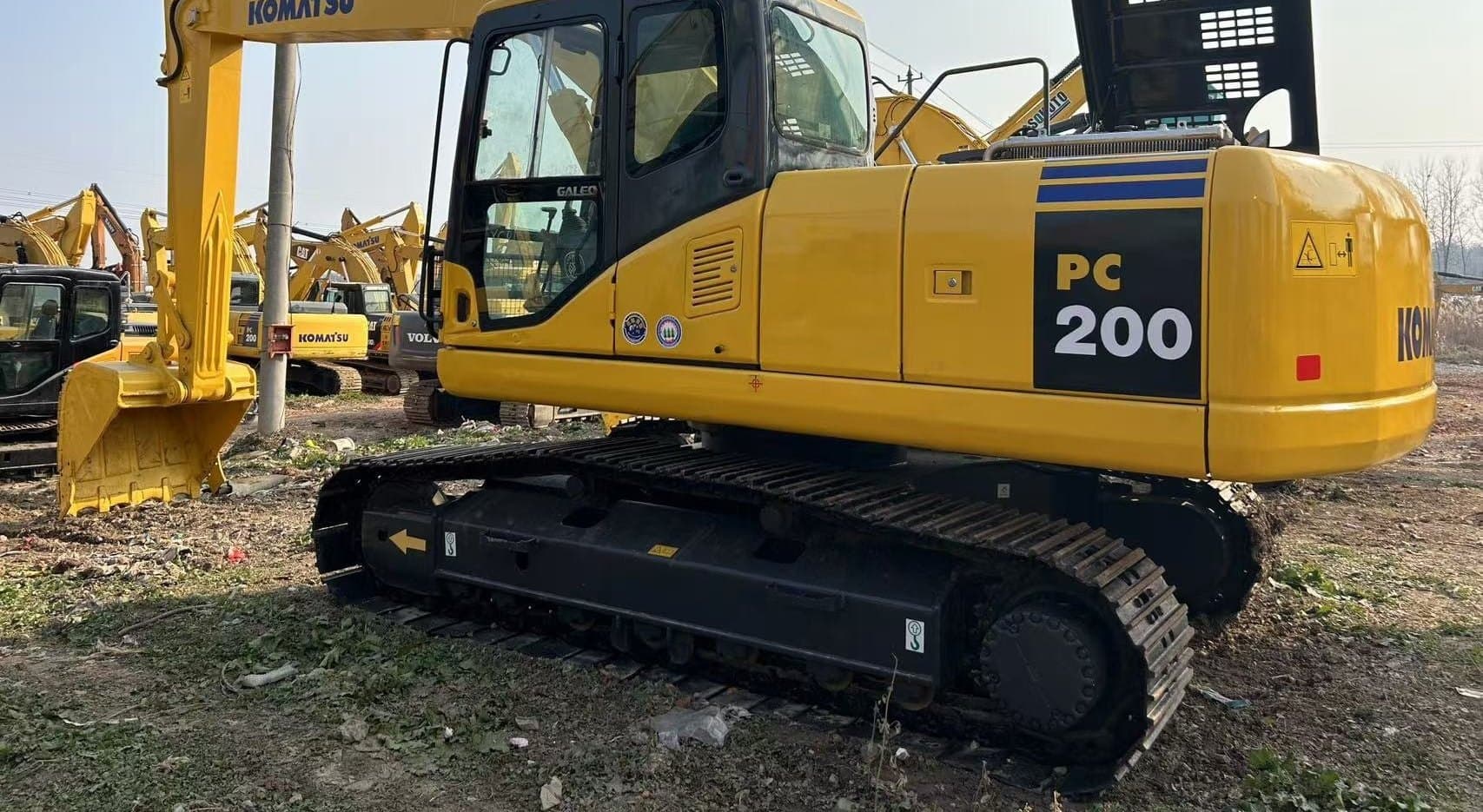
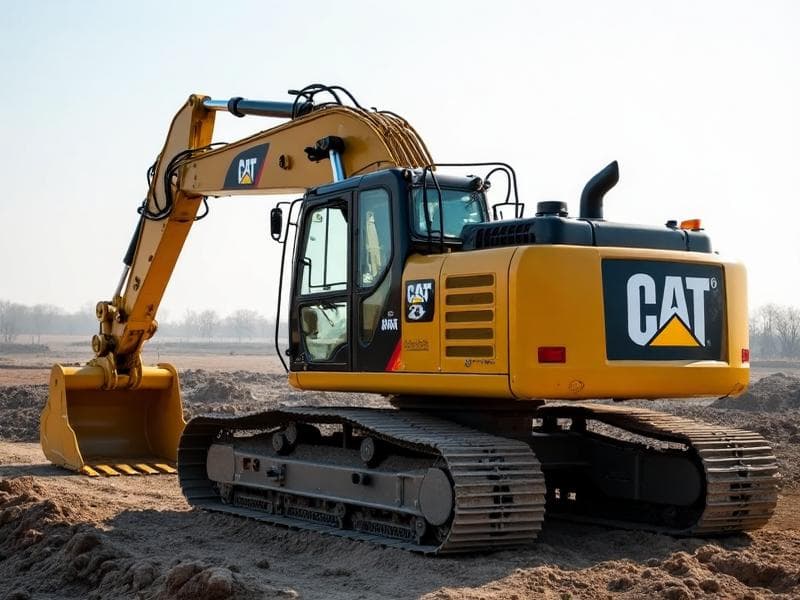
The Cat 320 and the Komatsu PC200 are the two machines most UAE contractors picture when they say "a 20-tonner". Both are common on hire fleets and both turn up on the used market. On the makers' sheets they are close: 21,300 kg for the Cat, 21,200 kg for the Komatsu. The differences are in reach, digging height, fuel tank, service intervals and how wide the machine is on the trailer.
This guide compares the two using the makers' own figures. One caution first: the two sheets describe different builds, and that matters more than any single number in the table.
Which builds we are comparing
- Cat 320. The next-generation 320 in the Tier 3 build for less-regulated markets, with the C7.1 engine, as sold by Al-Bahar in the UAE and GCC. The figures come from Cat's brochure for that build (AEXQ2332-09, 2024). Working ranges are for the 5.7 m HD Reach boom, 2.9 m HD Reach stick and 1.19 m³ HD bucket.
- Komatsu PC200. The PC200-8M0 with the standard undercarriage, 5,700 mm boom, 2,925 mm arm and 600 mm shoes. It comes from Komatsu Australia's 2015 brochure, the Australian and New Zealand specification. We could not find a Middle East PC200-8M0 sheet. Komatsu Middle East now lists the PC210-10M0 in this class, which is a different model, so we have not borrowed any of its figures.
So this is a current-generation Cat against an older Komatsu. If you are offered a newer Komatsu in this class, ask for its own sheet rather than assuming the PC200 numbers carry over.
Side by side
All figures are the maker's. Cat: its spec sheet for the Gulf (Tier 3) build. Komatsu: its Australian-specification brochure.
| Cat 320 (Tier 3, Gulf build) | Komatsu PC200-8M0 (Australian spec) | |
|---|---|---|
| Operating weight | 21,300 kg | 21,200 kg |
| Max digging depth | 6.72 m | 6.62 m |
| Max reach at ground level | 9.86 m | 9.70 m |
| Max digging height | 9.37 m | 10.00 m |
| Max dumping height | 6.49 m | 7.11 m |
| Max vertical wall digging depth | 5.19 m | 5.98 m |
| Depth of cut, 2,440 mm level bottom | 6.55 m | 6.37 m |
| Bucket capacity | 1.19 m³ (HD bucket) | 0.8 m³ |
| Overall length | 9.53 m | 9.425 m |
| Overall width | 2.98 m | 2.80 m |
| Track gauge | 2.38 m | 2.20 m |
| Tail swing radius | 2.83 m | 2.75 m |
| Overall height (to top of cab) | 2.96 m | 3.04 m |
| Shoe width | 0.6 m | 0.6 m |
Read the table with three points in mind.
- The Cat digs a little deeper and reaches a little further. The gaps are 10 cm on depth and 16 cm on ground-level reach. On a trench job that is rarely the deciding factor, but it counts when you are working near the limit of the boom.
- The Komatsu digs higher and dumps higher, and cuts a deeper vertical wall. Its dumping height is 7.11 m against 6.49 m, which helps when loading high-sided tippers from a face. The vertical wall figure is 5.98 m against 5.19 m.
- The bucket capacities are not like for like. The Cat figure is for a 1.19 m³ HD bucket, the Komatsu figure is for 0.8 m³. Do not read the difference as "the Cat moves 50% more per pass". Ask the supplier which bucket is actually on the machine.
Engine and power
| Cat 320 | Komatsu PC200-8M0 | |
|---|---|---|
| Engine | C7.1 | Not named in our data |
| Displacement | 7.01 L | 6.69 L |
| Net power | 117 kW (157 hp), ISO 9249, at 1,800 rpm | 103 kW (138 hp), ISO 9249 / SAE J1349, at 2,000 rpm |
| Gross power | 118 kW (158 hp), ISO 14396 | 110 kW (147 hp), SAE J1995, at 2,000 rpm |
| Main pump flow | 429 L/min | 439 L/min |
The Cat's net figure is 14 kW higher on paper, but the two are rated at different engine speeds and the gross figures follow different standards, so treat the gap as a rough guide only. The Komatsu has the slightly higher pump flow. In the field, the condition of the machine will tell you more than these small differences.
Digging force
The Cat sheet gives a bucket digging force of 150 kN and an arm digging force of 106 kN. The standard those figures are measured to is not recorded in our data. The Komatsu sheet gives two sets:
| Komatsu PC200-8M0 | Bucket | Arm |
|---|---|---|
| ISO rating | 149 kN | 108 kN |
| SAE rating | 138 kN | 101 kN |
If the Cat figures follow ISO, the two machines are within 1 to 2 kN of each other. Do not push the comparison further than that without checking the standard on the Cat sheet.
Fuel tank and service intervals
This is where the running routine differs most, and it is easy to miss when you only look at the headline specs.
| Cat 320 | Komatsu PC200-8M0 | |
|---|---|---|
| Fuel tank | 345 L | 400 L |
| Hydraulic tank | 115 L | 135 L |
| Engine oil and filter interval | 1,000 h | 500 h |
| Hydraulic oil interval | 6,000 h | 5,000 h |
| Hydraulic filter interval | 3,000 h (return filter) | 1,000 h (oil filter) |
The Komatsu's larger tank means fewer refuelling stops on a long shift. The Cat's longer oil-change interval means fewer service visits over a month on site. The sheets in our data give no fuel burn per hour, so we cannot tell you which machine uses less diesel. Ask the supplier for the machine's actual consumption, or log it over a week. Our excavator rental cost guide explains why fuel deserves that attention.
The intervals above are the makers' schedules. Look at the machine's actual service record, not the schedule.
Transport and site access
The Cat is 18 cm wider overall (2.98 m against 2.80 m) and has a track gauge 18 cm wider (2.38 m against 2.20 m). The Komatsu is 8 cm taller to the top of the cab. If you are moving the machine between small sites, give your haulier the exact dimensions of the unit you are hiring, not the brochure. Cab guards, extra lights and a different bucket all change the answer.
Hire it
For a job of a few weeks, either machine will do the work, and the deciding factors are the operator, the delivery date and the supplier's service record. Ask for:
- The model year and hours on the meter.
- The bucket size on the machine.
- Who pays for diesel and delivery.
- A current inspection certificate.
- What happens if it breaks down: a replacement machine, or a credit for the days lost.
Here are the median rates currently listed for excavators on the site.
| Size | Listings | Rent per day | Rent per week | Rent per month | To buy (used) |
|---|---|---|---|---|---|
| All Excavators | 507 | AED 1,200 | AED 6,750 | AED 17,300 | AED 150,000 |
| Over 30 t | 167 | AED 1,400 | AED 7,000 | AED 22,000 | – |
| 15 to 30 t | 252 | AED 1,100 | AED 6,050 | AED 16,000 | AED 110,000 |
| 6 to 15 t | 4 | – | – | – | – |
| Mini (under 6 t) | 5 | – | – | – | – |
Browse excavators for rent in the UAE and filter by model.
Buy it
If the machine will work most of the year, buying can pay back. When you look at a used unit:
- Confirm which Cat 320 you are looking at. Al-Bahar also sells the 320 GC and 320 GX, and our figures describe the standard 320 only.
- For a Komatsu, check the model designation on the plate. A "PC200" can be an older -8 or a newer generation, and the figures above apply to the -8M0.
- Ask whether it is a Gulf-specification machine or an import from another market. The Komatsu operating weight is for the Australian build with a quick hitch and bucket, and the maker's data notes that a Gulf-specification machine may weigh differently.
- Check undercarriage wear, pin and bush play on the boom and stick, and the hydraulic hoses around the boom foot.
- Ask for the service history against the intervals in the table above.
See used excavators for sale across the UAE.
The model pages
Our model pages carry the full maker data for each machine, with sources:
Which one?
Pick the Cat if you want the longer service intervals, the slightly deeper dig and a current-generation machine. Pick the Komatsu if you load high-sided trucks a lot, want the bigger fuel tank, or need the narrower machine on the trailer. If both are available on similar terms, choose the one with the better service record and the lower hours. In this class that matters more than the badge.