
Specification sheetIssued 20 November 2026
Peterbilt · truck
Peterbilt 520
Peterbilt Model 520 low-cab-forward refuse chassis, EPA 2024, left-hand drive with the MX-11 diesel: figures from the Peterbilt 520 Body Builder Manual (Feb 2024, Rev A Oct 2024), the peterbilt.com 520 specs page and the PACCAR MX-11 spec sheet. The back of the cab sits over the front axle; the chassis is built to the customer's body, so no wheelbase is published.
USAGlobal
- power
- 321 kW (430 hp)
- torque
- 2,237 Nm
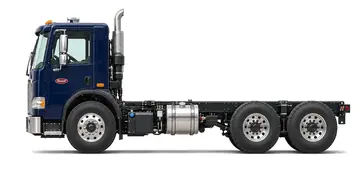 2.1 m
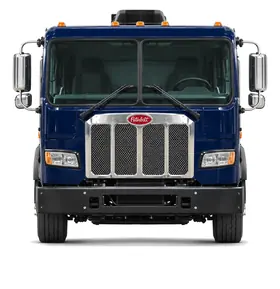
Dimensions
- Frame width (Single rail and inserted rail; 34.75 in (0.883 m) with inserted and outserted rail)
- 0.864 m
- Door opening (Door opening 33.4 in wide x 61 in high)
- 0.848 m x 1.549 m (33.4 in x 61 in)
- Cab tilt angle (Full 65 degree tilt, manual hydraulic pump or automated tilt)
- 65°
- Door opening angle
- 90°
- Front overhang (Bumper to front axle (BFA))
- 1.463 m
- Bumper to back of cab (BBC) (Estimate: the drawing places the back of cab directly above the front axle, so BBC equals BFA)
- 1.463 mest.
Engine
- Engine model (Diesel; the PX-9 and the two natural gas engines are also offered)
- PACCAR MX-11, 10.8 L in-line 6
- Gross power (Highest MX-11 rating listed for the 520 on peterbilt.com; PACCAR's MX-11 sheet lists up to 445 hp)
- 321 kW (430 hp)
- Max torque (Highest MX-11 rating listed for the 520 on peterbilt.com; PACCAR's MX-11 sheet lists up to 1,700 lb-ft at 900 rpm)
- 2,237 Nm
- Displacement
- 10.8 L
- Bore x stroke (Inline 6-cylinder)
- 123 x 152 mm (4.84 x 5.98 in)
- Governed speed
- 2,100 rpm
- Engine dry weight
- 998 kg
- Engine oil capacity
- 37 L
- MX-11 rating range
- 355-445 hp and 1,250-1,700 lb-ft (EPA 2024); 1,700 lb-ft at 900 rpm
- Engine PACCAR PX-9 (The 520 page lists up to 380 hp and 1,250 lb-ft; PACCAR's PX-9 sheet lists 260-450 hp)
- 8.9 L in-line 6, bore x stroke 114 x 145 mm, dry weight 1,695 lb (769 kg), oil 29 US qt (27 L), governed 2,100-2,200 rpm
- Engine Cummins X15N (Natural gas near-zero emissions engine)
- 14.5 L in-line 6, up to 500 hp (373 kW) and 1,850 lb-ft (2,508 Nm)
- Engine Cummins ISX12N (Natural gas)
- 11.9 L in-line 6, up to 350 hp (261 kW) and 1,450 lb-ft (1,966 Nm)
- Engine Cummins L9N (Natural gas)
- 8.9 L in-line 6, 320 hp (239 kW) and 1,000 lb-ft (1,356 Nm)
- Exhaust
- Vertical, horizontal, curved tip or 90 degree diffuser; behind the cab
- Emissions (Figure 3-1 is titled EPA 2024 Model 520)
- EPA 2024
Transmission
- Cab configurations
- Right-hand drive, left-hand drive, dual drive with right-hand stand-up, dual drive dual seated; ProBilt interior
- Gearbox
- Allison 3000, 4000 or 4500 Series automatic
Weight
- Gross vehicle weight (Up to 89,000 lb)
- 40,370 kg
- Front axle capacity (PACCAR, Dana or Meritor; the PACCAR 20K steer axle is standard (2019 brochure))
- 12,000-20,000 lb (5,443-9,072 kg)
- Rear axle capacity (Single, tandem or tridem; Dana or Meritor)
- 21,000-78,000 lb (9,526-35,380 kg)
- Lift axles (Self-steering or non-steering; Watson & Chalin or Hendrickson)
- Up to 3 factory-installed, 8,000-23,000 lb
- Engine maximum operating weight (MX-11)
- 49,895 kg
Chassis
- Front suspension
- Taper-leaf springs
- Rear suspension
- Peterbilt Air Trac, Air Leaf and Low Air Leaf; Hendrickson HMX EX; Neway ADZ; Reyco; Chalmers
- Frame rails (Rail bending moment = section modulus x 120,000 psi)
- Single rail 10-3/4 in x 3.50 in x 0.375 in, 17.8 cu in, RBM 2,136,000 in-lb per rail; built-up rails 28.9 cu in (3,468,000 in-lb) and 45.7 cu in (5,484,000 in-lb)
- Frame layout
- Under-cab frame rails splayed; 34 in wide; inserted and outserted sections stop before the rear suspension
- Cab construction (The 2019 refuse brochure calls it an all-aluminum cab)
- Galvanized steel cab frame with aluminum and fiberglass components; 90 degree door opening
- Bumper
- Aluminum or steel; polished, painted, chromed or swept back; up to 9 in extension
- Fuel tank (Largest tank listed: 150 gal useable (163 gal total), 26 in diameter; tanks from 40 gal useable)
- 568 L
- Fuel tank diameters
- 20, 23 and 26 in diameter
- Electrical
- VMUX electrical architecture with pre-configured frame layouts; 7 in digital display; LED headlamps; electronic stability control
- Cab
- Low-cab-forward tilt cab (65 deg); left-hand, right-hand, dual drive with right-hand stand-up, or dual seated