

15 Common Forklift Types, Classifications and Uses
Forklifts are versatile vehicles that can be used by workers in the construction industry, warehouses, and more. When moving heavy loads, forklifts can safely…
بقلم Wajahat Ali Usmani10 دقائق قراءة
Forklifts are versatile vehicles that can be used by workers in the construction industry, warehouses, and more. When moving heavy loads, forklifts can safely lift objects that humans cannot, making them indispensable on any job site. Whenever heavy loads need to be moved, forklifts are an essential tool because they can lift objects that humans cannot. There are numerous types and models of forklifts, making it challenging to choose the right one. This comprehensive guide explains the 15 distinct types of forklifts, their advantages, reputable forklift brands, and the seven categories of forklifts to help you pick the right one for your next project.
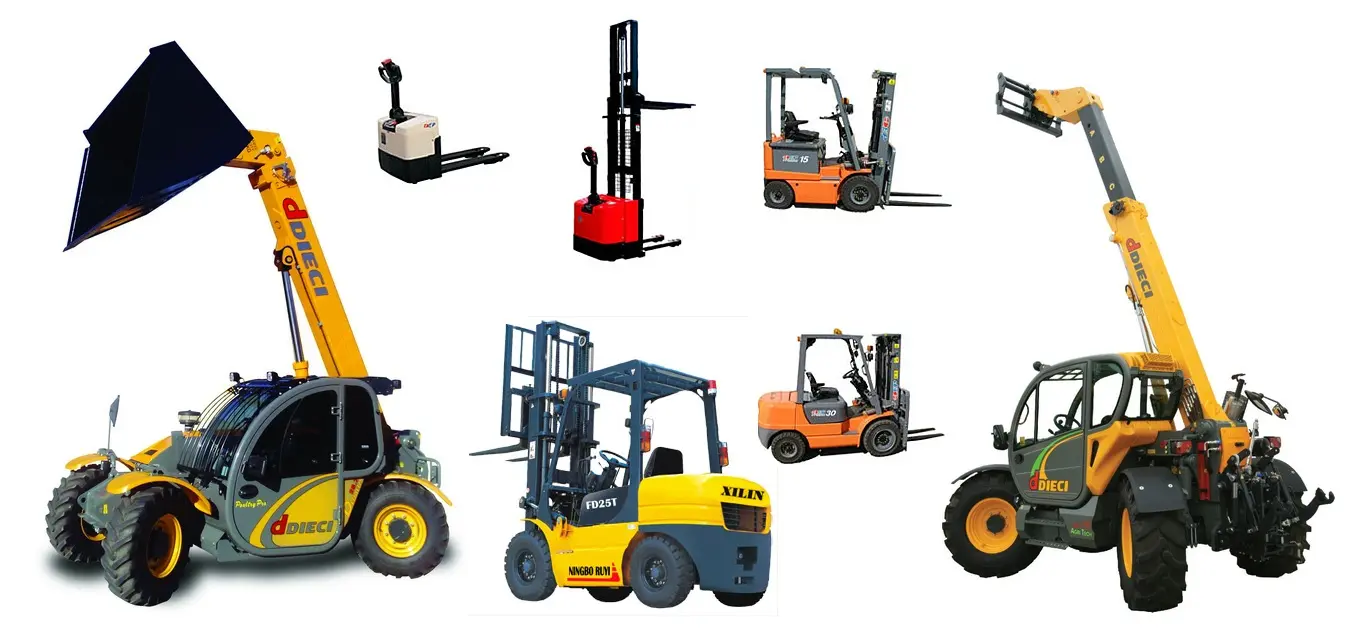
15 Common Forklift Types
1. Counterbalance Forklift
The counterbalance forklift is one of the most common types of lifts used for counterbalancing the weight of a load. The forks are located at the front, and a weight is positioned at the back of the lift. Due to their lack of extended arms, counterbalance forklifts can move straight toward their load.
There are several types of counterbalance forklifts. With a stand-up counterbalance forklift, operators can easily switch between loads, while the 3-wheel version is ideal when the operator must navigate in circles. Among the most well-known producers are Crown, Toyota, and Mitsubishi.
Common Uses:
Warehouse storage
Manufacturing
Distribution centers
2. Rough Terrain Forklift
A rough-terrain forklift also referred to as a straight-mast forklift, is designed specifically for outdoor job sites with uneven surfaces. These trucks have oversized, threaded pneumatic tyres, which provide better balance and stability on rocky terrain. When working outdoors or on construction sites, rough-terrain forklifts are a must, even if you do most of your work indoors.
There are several popular models available, including the CASE 588H and the JCB 950. Besides being able to lift heavier loads, rough terrain forklifts can also lift loads of up to 6,000 lbs or 8,000 lbs.
Common Uses:
Construction
Logging
Outdoor heavy lifting
3. Warehouse Forklift
Warehouse forklifts are the most commonly used lift trucks. It resembles a golf cart with two forks on the front. When used at a facility with a large inventory, this forklift can load and unload pallets as well as move goods to and from delivery trucks.
Some of the most popular warehouse forklift models include the Toyota 3-Wheel Electric Forklift, Komatsu 20 BX50 Hyster, and Hyster 36-38T. Many industrial forklifts have a 5,000-pound weight capacity, while some heavy-duty models have a 25,000-pound capacity. Warehouse forklifts can be side loaders or counterbalanced.
Common Uses:
Short distance lifting
Moving of objects
Inventory management
4. Telehandler
Telehandlers, also known as telescopic forklifts or reach forklifts, combine the functions of a crane and a forklift with a boom and an extendable arm. Pallets are moved off the ground using the twin forks attached to the arm. Typical telehandlers can lift 5,500 pounds to 19 feet and reach into tight spaces and odd angles.
Manufacturers such as JCB, Genie, Bobcat, Haulotte and Caterpillar produce high-quality telehandlers due to their growing popularity. Some models, such as the JLG 1644, can lift loads up to 55 feet high, while others are better suited for smaller jobs.
Common Uses:
Construction sites
Farm operations
High-reach outdoor storage
5. Heavy-Duty Forklift
Heavy-duty forklifts, also known as large-capacity forklifts, combine the functionalities of both warehouse forklifts and telehandlers. Although it can't reach difficult angles like a telehandler, it can lift heavier loads much higher than a warehouse forklift. A smaller, heavy-duty forklift starts with a 30,000-lb maximum lift, but a heavy-duty forklift with a 100,000-lb lift is available if needed.
Forklift manufacturers make heavy-duty forklifts in 20 different models. Some popular models boast a 36,000-lb capacity, including models from NACCO Industries and Mitsubishi.
Common Uses:
Heavy manufacturing
Steel handling
Shipping containers
6. Walkie Stacker (Walkie Forklift)
Walkie stackers have a distinctive look and a particular purpose. They are not equipped with cabs like regular forklifts. A handle attached to the stacker is used to steer it while the operator walks behind it. When a taller pallet jack is needed, these machines are ideal, but they are not very powerful, agile, or fast. Walkie stackers can reach higher than pallet jacks of the past.
Walkie stacker forklifts are currently manufactured by Toyota, Hyster, and Jungheinrich. When it comes to 4,000-lb weights, Toyota's 6BWC20 is the best option, while Jungheinrich's EMC 110 is the best option for narrow aisles.
Common Uses:
Small warehouses
Inventory backrooms
Distribution centers
7. Pallet Jack Forklift
Pallet jacks are inherently specialised machines. These pallet lifts, also known as pump trucks, cannot carry heavy loads. Due to their compact design, pallet jacks can lift small loads in confined spaces and fit into narrow areas. Renting or purchasing a pallet jack is significantly less expensive than renting or buying a truck.
Vestil Electric Pallet Trucks and Mighty Lift 20 x 36 Inch Pallet Jacks are two popular models. Both electric and manual pallet jacks can be purchased or rented. The compact size and either battery or manual operation are the key features of this product.
Common Uses:
Supermarkets
Small warehouses
Retail stores
8. Reach Fork Truck
Reach forklifts are warehouse trucks used mainly indoors. In comparison to standard forklifts, it can extend its forks beyond the compartment and reach into warehouse racks. Additionally, there is an open compartment that provides the operator with greater visibility.
Due to their minimal undercarriage clearance, reach trucks are not suitable for outdoor work. UniCarriers, Clark Materials, and Yale manufacture some of the best-reach forklifts.
Common Uses:
High rack storage
Narrow aisle warehouses
Retail inventory management
9. Order Picker
An order picker is a subtype of a walkie-stacker that picks and delivers materials from storage. Lifting operators up to and carrying individual units from warehouse racks, these machines reach up to 32 feet. Because they can pick individual units without having to bring down full pallets, they excel in customer order warehouses and storage facilities. Whether it's auto parts or furniture, they can handle items of various sizes because of their versatile design.
Common Uses:
E-commerce fulfilment centres
Retail warehouses
Inventory management
10. Side Loader Forklift
Typically, side loaders are used in manufacturing plants and steel service centres that handle long, heavy goods, such as timber and pipes.
Side loaders unload items while the operator stands sideways. Sideloader forklifts can load and unload effortlessly alongside racks because they operate sideways. Because of this, they are able to work in tight spaces and with long loads, such as pipes and lumber. Toyota, Raymond, Hyundai, and Yale are among the primary manufacturers of side loaders.
Common Uses:
Lumber yards
Steel and pipe warehouses
Long material storage
11. Articulated Forklift
An articulated forklift features a flexible mast that can bend, allowing it to navigate very narrow aisles while lifting heavy loads. These trucks combine the benefits of reach trucks and counterbalance forklifts in one machine.
Common Uses:
Narrow aisle warehouses
High-density storage
Distribution centers
12. Compact Forklift
Compared with traditional forklifts, compact forklifts are much smaller. Designed for use in tight indoor spaces where manoeuvrability is critical, they are ideal for use in confined areas. Typically, they are powered by electricity and do not produce any emissions.
Common Uses:
Indoor warehouses
Food storage facilities
Manufacturing
13. Electric Forklift
Forklifts that operate on electric power are quiet and emission-free because rechargeable batteries power them. Ideally, they should be used indoors where there is a requirement for clean air and low noise levels. Compared to fuel-powered forklifts, they have fewer moving parts, making maintenance easier.
Common Uses:
Indoor warehouses
Food storage facilities
Pharmaceutical and cleanroom environments
14. Truck-Mounted Forklift (Piggyback Forklift)
A truck-mounted forklift is attached to a delivery truck. Cargo is unloaded as soon as the forklift detaches from the truck at its destination. Their versatility makes them ideal for deliveries where there is no on-site equipment for unloading.
Common Uses:
Delivery services
Construction supply deliveries
Remote job sites
15. Hydraulic Forklift
Hydraulic forklifts use pressurised fluid to lift and lower the forks. The system offers smooth and precise lifting, allowing it to handle a wide range of load weights with ease. Hydraulic systems are used in most forklifts today.
Common Uses:
Manufacturing plants
Loading docks
General warehouse operations
Classifications of Forklift
While there are ten different types of forklifts, there are also seven different types of classification. Forklift operators must be aware of the required forklift safety practices and be certified on each class of forklift before operating one. Here are the different classifications of forklifts.
Class I: Electric Motor Ride Truck
Designed specifically for use indoors with poor air quality, Class I forklifts are powered by batteries. Warehouse and counterbalance forklifts are examples of electric motor ride trucks.
Type of Fuel: Battery
Use: Warehouses and other indoor settings
Class II: Narrow-Aisle Electric Motor Truck
Forklifts in Class II can squeeze into and navigate through narrow openings, such as warehouse aisles. The batteries are rechargeable and designed exclusively for indoor use.
There are various electric motor narrow aisle vehicles, including reach forklifts, side loaders, order pickers, and walkie stackers.
Type of Fuel: Battery
Use: Transporting stock in confined or constrained spaces
Class III: Electric Motor Hand Truck
Another type of battery-operated forklift is the Class III. This class of forklifts allows the operator to manually move the truck and then raise and lower the forks using controls rather than cabin or joystick controls. Powered pallet jacks are examples of electric motor hand trucks.
Type of Fuel: Battery
Use: Unloading short-distance delivery trucks quickly
Class IV: Internal Combustion Engine With Cushion Tires
Class IV forklifts are similar to Class I forklifts, but their main difference lies in their fuel type and tyres. Since these forklifts are powered by gas or diesel, they emit fumes into the environment, making them unsuitable for indoor settings. Although cushion tyres are designed for smooth surfaces, they are not suitable for rough terrain; however, they may be suitable for some outdoor projects.
Warehouse lifts and counterbalance lifts that require fuel rather than charging are examples of internal combustion engines with cushion tyres.
Type of Fuel: Gas or diesel
Use: Situations with low clearance
Class V: Pneumatic Tired Internal Combustion Engine Trucks
Despite their different classifications due to their tyres, class V and IV forklifts are comparable. The pneumatic tyres on these trucks provide excellent shock absorption, making them suitable for uneven terrain.
Heavy-duty forklifts, warehouse trucks, and counterbalance trucks use pneumatic tyres and internal combustion engines.
Type of Fuel: Diesel or gasoline
Use: Indoor and outdoor rough surfaces
Class VI: Tractors with Internal Combustion and Electric Engines
Forklifts of class VI are more often used for towing than lifting. They can tow loads up to 55,000 pounds. These kinds of trucks can be found both indoors and outdoors at airports and warehouses. An electric-driven tugger has an internal combustion engine and an electric drivetrain.
Type of Fuel: Gas, Diesel, or Batteries
Use: Hauling or towing cargo
Class VII: Rough Terrain Forklift Truck
A Class VII lift is designed for use on rough, uneven surfaces, such as gravel or dirt paths. Lifts of this type are designed for outdoor use and feature specialised tyres and counterweight to maintain stability during transportation over various terrains. Telehandlers and rough-terrain forklifts are examples of rough-terrain forklift trucks.
Type of Fuel: Gas or diesel
Use: Uneven ground, high-elevation lifting, construction sites
How to Choose the Right Forklift for Your Business?
Forklift types are determined by several factors, including:
Load Capacity: What is your typical load weight?
Lift Height: How high should you lift materials?
Operating Environment: Do you operate indoors or outdoors? Do you prefer smooth or rough surfaces?
Space Constraints: Are there any narrow aisles?
Fuel Type: Is it electric, diesel, or gas-powered?
With EquipmentsFinder, you can find the perfect forklift for your business. Among our wide selection of forklifts, you're sure to find the equipment that boosts your efficiency and safety.
Conclusion: Choose the Right Forklift
Forklifts are valuable players on any job site due to their ability to lift and transport materials of different sizes. If you need a forklift for your project, you also need a reliable equipment rental company.
EquipmentsFinder carries a large variety of forklift trucks. With EquipmentsFinder, you can rent all types of construction equipment, whether you need pallet jacks or heavy-duty forklifts. Our convenient on-site delivery and pickup service makes renting and returning equipment easy for you. We're here to help you make smart equipment decisions, whether you manage a small warehouse or operate a large operation.


